Monday, 25 March 2013

Google Advanced SEO CODE|Google SEO Expert| arif anjum| Lahore Pakistan|SEO Training in Lahore pakistan

Earn with your own website

You can earn a decent amount of money 

if you dedicate some advertising space on your website or blog. 

You will get paid when someone clicks on a ad placed on your website or blog.

Earn for visiting sites - You can Earn a few cents per website you visit,

 through a specific paid to click network.

Earn by Writing article - There is thousands of websites want to pay you for your article or writings.

Get paid to signup - You can earn some money by joining a website as a member.

Work from home jobs - Actually i am talking

 about freelance and outsourcing jobs with what you can earn your livelihood.

Earn money with your own website

If you have your own website or blog with good number of visitors,

 then you can earn a good amount of money by placing advertisements on your website. 

There are some third party websites what serves ad on your webpage and pays you.

 All you need to do is just register with one of them and after logging into your account

 you will get some HTML ad code. Then place those codes on your webpages and ads will start appearing.

 The thirdparty website will pay you on the basis of how much visitor views and clicks on those ads.

 Finally after each month you will get paid via check, paypal or other payment systems.

Premium Membership Upgrades

YOU Premium Members Commission rate by level Earnings for this level Total Earnings
Level 1 5 members $2.00 each $10.00 $10.00
Level 2 25 members $1.00 each $25.00 $35.00
Level 3 125 members $1.00 each $125.00 $160.00
Level 4 625 members $1.00 each $625.00 $785.00
Level 5 3,125 members $1.00 each $3,125.00 $3,910.00
Level 6 15,625 members $1.00 each $15,625.00 $19,535.00
Level 7 78,125 members $1.00 each $78,125.00 $97,660.00
Level 8 390,625 members $1.00 each $390,625.00 $488,285.00

This is where the true power of the basic affiliate program comes into play.
 With 8 levels there's no limit on how much you can earn,
 although you'll have to upgrade yourself to take full advantage of this 
because Standard members earn only from their direct referrals. Whenever your direct referrals upgrade
, you're instantly paid $2.00! If you are a Premium member and if 
your referrals refer others who also upgrade
 you are instantly paid $1.00 for each upgrade through 8 levels! You just got paid for doing nothing!
The Standard membership is FREE. 
A Premium membership upgrade costs only $17.00 USD for 1 year, a fraction of what other wst  websites charge.

Below is an illustration of what could happen if you refer only five new members 
 who upgrade to a Premium account and your downline members do the same...through all eight levels:
Just imagine the possibilities if you and the others in your downline refer 3, 4, 5, or more members
 who upgrade to Premium each month!
Of course, this isn't the typical earnings that a member will receive. However, 
it does show the unlimited earning potential that ClixSense can provide to its members. As with anything else, 
the rewards that you receive is determined by the effort that you put into it.

Make Money With wst
wst offers one of the most lucrative affiliate programs in the wst  industry.
 Not only are you compensated for referring others you also get commissions
 whenever your direct referrals click on wst  Ads, complete tasks,
 purchase advertising or whenever they or their referrals upgrade to Premium through 8 levels!
 With multiple streams of income your earnings potential is unlimited.


arif anjum

arif anjum


Google Advanced SEO CODE|Google SEO Expert| arif anjum| Lahore Pakistan|SEO Training in Lahore pakistan


How to Track Outbound Links using Google Analytics

For sure you have some outbound links in your website going to other websites for various reasons. We sometimes cite other websites as sources of fun, information, or attribution, etc. You can track which outbound links are clicked by your users by adding a short, simple code in your Google Analytics Tracking code.
Where are you Going?
For sure you’d like to see where your visitors are headed to after they’ve been through your website. Tracking where all your outbound traffic is headed can tell you which outbound links are doing well in your website and which are not. Here’s the code to track all outbound links in your website:
<script type=”text/javascript“>
var a = document.getElementsByTagName(‘a’);
for(i = 0; i < a.length; i++){
if (a[i].href.indexOf(location.host) == -1 && a[i].href.match(/^http:///i)){
a[i].onclick = function(){
_gaq.push(['_trackEvent', 'outgoing_links', this.href.replace(/^http:///i, '')]);
}
}
}
</script>
What this code does is it gets all your <a> tags (which is what your links are made out of) and appends an onClick function to it. The onClick function will create an Event Category which will be outgoing_links, and the event action will be the URL.
Put this below your Google Analytics Tracking code like this (highlighted in blue):
<!–THIS IS YOUR GOOGLE ANALYTICS TRACKING CODE–>
<script type=”text/javascript”>
var _gaq = _gaq || [];
_gaq.push(['_setAccount', 'UA-xxxxxxxx-x']);
_gaq.push(['_trackPageview']);
(function() {
var ga = document.createElement(‘script’); ga.type = ‘text/javascript’; ga.async = true;
ga.src = (‘https:’ == document.location.protocol ? ‘https://ssl’ : ‘http://www’) + ‘.google-analytics.com/ga.js’;
var s = document.getElementsByTagName(‘script’)[0]; s.parentNode.insertBefore(ga, s);
})();
var a = document.getElementsByTagName(‘a’);
for(i = 0; i < a.length; i++){
if (a[i].href.indexOf(location.host) == -1 && a[i].href.match(/^http:///i)){
a[i].onclick = function(){
_gaq.push(['_trackEvent', 'outgoing_links', this.href.replace(/^http:///i, '')]);
}
}
}
</script>
<!–END RECORD OUTBOUND LINKS CODE–>
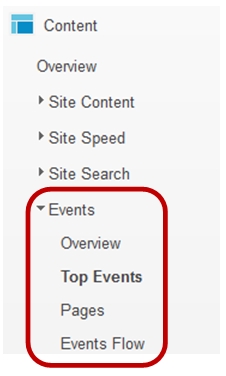
This should track all your outbound links. You can check this at the Content -> Events section when you go to your Google Analytics account.
arif anjum
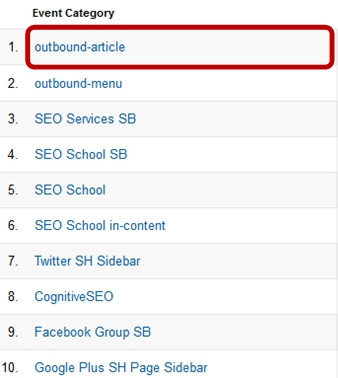
You will be able to see something like this:
https://plus.google.com/b/110806270621867426627/110806270621867426627
(Click the Image to Enlarge)
Event Category is the name of the event. In this example, it is the name of my outbound links – if you noticed, I customized my Events Categories giving them names like ‘SEO Services SB’, ‘SEO School SB’, ‘Facebook Group SB’, etc. You can also customize your Event Categories by using the onClick function for Google Analytics Events tracking here.
Total Events is the times the Event occurred – in this case, it’s the number of times my outbound link was clicked by a user.
Unique Events is the times the Event occurred for a Unique IP address – in this case, it’s the number of times my outbound link was clicked by a Unique user.
Event Value and Avg Value can be set on Goals Settings. As of now, we will not use these.
Where are You Going?
If you check out my Event Categories, I name my links to my understanding. For example, I append an ‘SB’ label to my sidebar links to see if they are clicked more often than their in-content or image counterparts. For this timeframe, it strongly suggests that my sidebar links are the most clicked links – particularly my SEO Services link and SEO School link.
arif anjum
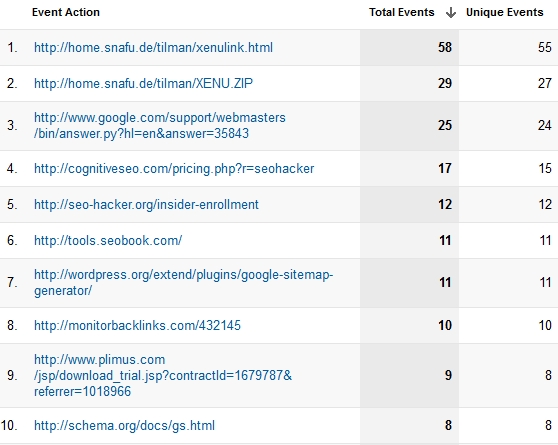
If you want to check your outbound links without the categories simply click the ‘outbound-article’ Event Category and it should take you to the raw URLs of your outbound links.
www.olxonline.com
The results should look like this:
www.olxonline.com
One More Trick
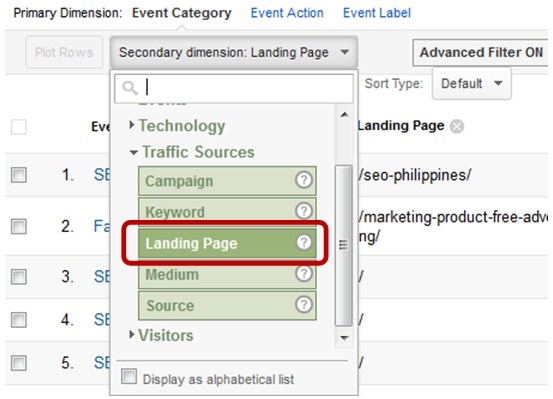
When you’re tracking site-wide outbound links, you can check which pages prove most effective in compelling your users to click-through. Simply add a secondary dimension like this:
Outbound Links Landing Page Dimension
Then filter the results such that it won’t show you anything but your site-wide links (you shouldmanually put a customized onClick Events Tracking code in your Site-wide links to effectively track them.) First, click on the Advanced Filter link:
Google Analytics Advanced Filtering
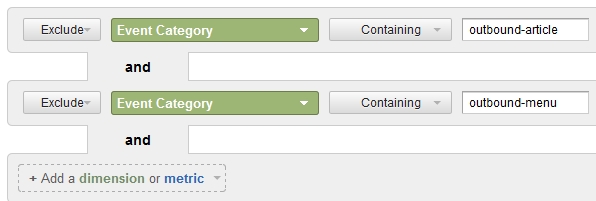
Then Exclude all non site-wide links (Event Category) in my case it is labeled as an ‘outbound-article’ and an ‘outbound-menu’ :
Advanced Filter for Outbound Links
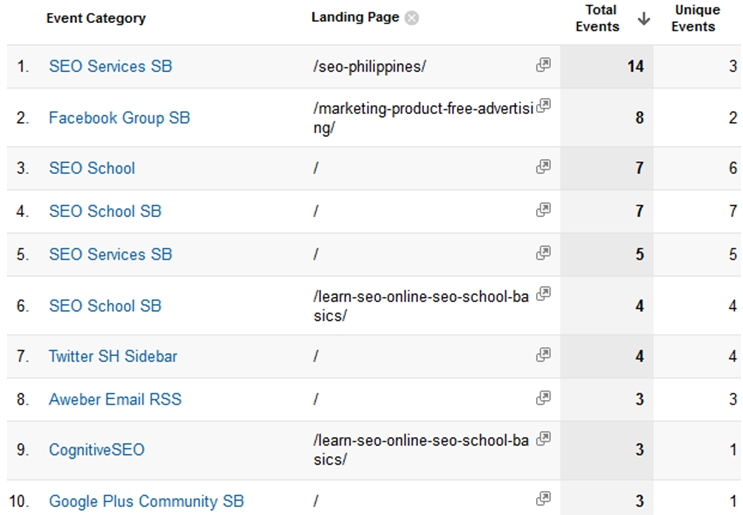
Your Google Analytics should show you data that looks like this:
arif anjum
This data tells me on which landing page has any of my site-wide links have been clicked. This is especially helpful if you are testing sidebar ads, banners, links or email signup forms.
Tips for Keeps: Implementing this Google Analytics Outbound Links Tracking code is a piece of cake – paste the code beside your Google Analytics Tracking code to start gathering your outbound user activity data.
Arif anjum

Arif anjum

Google Advanced SEO CODE|Google SEO Expert| arif anjum| Lahore Pakistan|SEO Training - Classified Ad

Google Advanced SEO CODE|Google SEO Expert| arif anjum| Lahore Pakistan|SEO Training - Classified Ad

Wst is an ethical and professional SEO Agency in pakistan also offer Website Designing and Website Development services.
 Our dedicated SEO pakistan  experts are highly talented to achieve first page ranking in local search engine and global ranking for your website.
We (SEO Firm) have attained the degree of specialization and have satisfied 300+ clients globally with their SEO needs.
Being one of th top most SEO services company across the vertical,
 we understand better how important your online business presence is.
 This is why our SEO experts work with a very holistic and extensive approach to enhance your brand visibility.
Top rankings in search engines like Google, Yahoo and Bing requires best tools and techniques as well as ethical SEO practices.
 Our Team of Search Engine Optimization experts are industry leading individuals
 who are fully focused on greater sync with the practices to ensure only the best results.
Government of Pakistan se Registerd


search Engine Optimization Training Classes, SEO Training from SEO Experts|Arif Anjum 
government of pakistan se registerd

SEO Training Pakistan Search Engine Optimization Training Classes Karachi Lahore Multan Islamabad Sialkot

 Bahawalpur Hasilpur Arifwala chishtain Pakistan (Urdu/Hindi/English) Google Adsense Optimization Training

100% Online Earning Success Ways Training with SEO Programs

Live Project for Ur Own Online Business  mean while u will establish your business     

roject Based Assignment
Live Project Work

ü Certificate

ü Free Course Material


SEO Training In Lahore | SEO Urdu Tutorial | Google Adsense Urdu Tutorial 

wst|Chishtian


SEO Services in Lahore|Advance SEO Services in lahore by arif anjum SEO Expert

SEO training in Lahore | SEO Courses, SEO institute Lahore Pakistan

Online SEO, SEM & Web  Training  UAE, Pakistan, , Australia,india
Best SEO, Google Adwords, , SMO, Social Media Marketing, Web Analytics, 
Search Engine Optimization Training Class Registrations


Get in Touch
Cell :+923124484957
Call : +923134991116
Skype : arif.sohail5
Arif Anjum Firdous market Gulberg III Lahore, Pakistan


arif anjum

arif anjum


Sunday, 24 March 2013

advanced seo|arif anjum|seo|advance seo in pakistan

3 Advanced SEO Techniques You Need to Know

advanced SEO,SEM,SEO,SEO TECHNIQUES,FACEBOOK MARKETING,


The world of search engine optimization is a complicated one, and if you’re a “non-techie” business owner who’s been thrown into webmaster duties for the simple sake of having a business web presence, just learning the basics of SEO might seem overwhelming.

Unfortunately, the web’s search engine spiders don’t care about how skilled you are in the technical arena.  What they care about is the content they can read on your pages, so if you aren’t utilizing both basic and advanced SEO techniques on your website, you risk being indexed and ranked for the wrong words – or none at all!

For this reason, it’s important to familiarize yourself with SEO techniques and to implement SEO best practices to the best of your abilities.  Fair warning – the following three topics may seem complex.  However, if you invest a little time in reading more about them, you should be able to implement them in a way that makes sense for you and your website.

Let’s get started!

Technique #1 – Canonicalization

Canonicalization sounds tricky, but it’s not that difficult to understand.  Essentially, there are a number of situations that can cause content on your website to appear on multiple URLs.  These instances can cause your site to be indexed improperly or to trigger duplicate content filters, in which the search engine spiders must determine which version of your content (if any) to display in the SERPs.

The easiest example to understand is that your website can be accessed from both “http://www.mysite.com” and “http://mysite.com”.  If you have inbound links pointing at both of these URLs, they’ve likely both been indexed by the search engine spiders, which can lead to complications in terms of how link juice is passed and how your site appears in the SERPs.

Similarly, if you use a platform like WordPress (which dynamically creates category and tag pages that display your articles in multiple locations) or a service that adds tracking or session IDs to your URLs (for example, “http://www.mysite.com/file.php?var1=value&mysession=123”), the search engines could be indexing multiple copies of your original articles.

To prevent these situations from influencing where and how your site is ranked in the SERPs, consider implementing the following best practices:

Use a 301 redirect (which we’ll get into next) to ensure your site is indexed at either the “www” version or the “non-www” version of your domain name (not both).
Build any external backlinks using the same URL structure you set with your redirect.
Use caution when building your site to ensure all internal links are structured the same.
Add the rel=”canonical” tag to your pages to specify which URLs should be indexed by the search engines.  Be aware, though, that this is only a suggestion – the search engines are not required to adhere to the URL preferences you specify with this tag.
For more recommendations on how to handle canonicalization issues, take a look at the following resources:

8 Canonicalization Best Practices in Plain English
What is Canonicalization?
About rel=”canonical”
Technique #2 – Redirects

Deploying proper redirects on your site follows a similar principle as canonicalization.  That is, if you move content on your website (or from one website to another), you’ll want to be sure the search engine spiders are properly informed of the move and able to find and access your content in its new location.

There are two types of redirects that are commonly used in web development: 301 and 302.

301 redirects are permanent redirects.  Using this specific code tells the search engines that your content has been moved permanently and should be indexed at its new location.  301 redirects have the advantage of passing link juice and accumulated SEO authority to your content’s new home, which makes them incredibly valuable from a search perspective.

302 redirects, on the other hand, are temporary redirects.  A 302 redirect tells the search engines, “I’ve moved this content temporarily, but it will be back.  Please don’t attempt to redirect SEO authority away from my original URL.”

In most cases, you’ll want to use 301 redirects to control how the search engines index moved or deleted content.  To learn how to deploy this type of redirect correctly, check out the following articles:
advanced seo
wst

Redirection SEO Best Practices
URL Rewrites and Redirects: The Gory Details (part 1 of 2)
URL Rewrites and Redirects: The Gory Details (part 2 of 2)
Technique #3 – Schema.org microdata

Microdata – which sounds significantly more complicated than it really is – is a language that’s used to add supplementary tags to your site’s HTML in order to provide more data to the search engine spiders and result in the creation of “Rich Snippets.”

When you think about the tags included in traditional HTML, it’s easy to see where some major deficiencies lie.  Typically, the only tags found in your site’s code include the body tag, title tag, meta description tag, heading tags and a few others.  While the search engines are able to capture the data stored in these tags, they occasionally run into challenges analyzing this information qualitatively.

For example, suppose you built a website reviewing the popular movie, “Avatar.”  Your initial code might look something like this:

<div>

<h1>Avatar</h1>

<span>Director: James Cameron (born August 16, 1954)</span>

<span>Science fiction</span>

<a href=”../movies/avatar-theatrical-trailer.html”>Trailer</a>

</div>


And while the search engine spiders will be able to tell that you’ve written a page about the word “Avatar”, they can’t conclusively determine from this limited text whether your content is about the movie or about online profile pictures.

By adding Schema.org microdata, we can add extra information within our website’s code to instruct the search engines on how to process and index this content.  In the following example, the sample code shared above is modified with the “Movie” schema tag, which informs the search engines that what follows is content based on a movie called “Avatar”:

<div itemscope itemtype ="http://schema.org/Movie">
  <h1 itemprop="name">Avatar</h1>
  <span>Director: James Cameron</span> (born August 16, 1954)</span>
  <span Science fiction</span>
  <a href="../movies/avatar-theatrical-trailer.html">Trailer</a>
</div>


Not only does this Schema.org microdata help our sites to be indexed more appropriately.  When integrated correctly, sites marked up with microdata become eligible to use “Rich Snippets” (basically, SERPs listings with additional information) in the search results pages.  These snippet enhancements can result in an increased clickthrough rate from the SERPs, making the time needed to mark up a website with standard microdata well worth the effort.

The following image shows two SERPs listings that are fully marked up with Schema.org microdata and two that are not.  If you wound up on this results page, which result would you be more likely to click through to?


arif anjum
arif anjum

Thursday, 28 February 2013

wst|worldsolutionteam|arif anjum|advance seo|chishtian


What is Search Engine Spam?

A comprehensive list of sixteen tactics that are considered search engine spam. These techniques include:

  • Keywords unrelated to site
  • Redirects
  • Keyword stuffing
  • Mirror/duplicate content
  • Tiny Text
  • Doorway pages
  • Link Farms
  • Cloaking
  • Keyword stacking
  • Gibberish
  • Hidden text
  • Domain Spam
  • Hidden links
  • Mini/micro-sites
  • Page Swapping (bait &switch)
  • Typo spam and cyber squatting

Research & Analysis
A sizeable number of people approach the web for discounted deals that are otherwise more expensive. Let this point reflect on your web page through ouradvanced SEO. Providing discounts and freebies are one of the proven methods. The headline should give away immediately what the client is standing to gain. The smaller details and conditions if any can follow in the smaller print within the subsequent content.

chishtian arif anjum

chishtian